


Data Work and Data Labelling
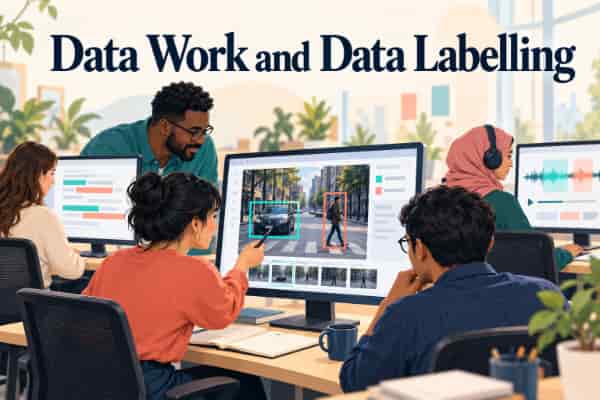
Data workers play a critical role in sustaining global AI value chains. Data work is dispersed across transnational value chains that include data labelling, content moderation, and downstream AI deployment.
Large-scale annotation projects and moderation pipelines increasingly rely on distributed human labour to produce the training datasets and safety signals that underpin modern AI systems.
Broadly, data work includes tasks such as data collection, annotation, labelling, tagging, classification, transcription, processing, and content moderation.
- The World Bank estimates that there are between 150 to 430 million digital and data laborers worldwide, million digital and data laborers worldwide, a vast majority of whom reside in the Global South.
- Globally, the digital gig workforce encompasses hundreds of millions of people, constituting roughly 4.4% to 12.5% of the global labour force.
- The global digital labour market is expanding at a Compound Annual Growth Rate (CAGR) of 17.20% and is projected to scale up to USD 23.7 billion by 2034.
- The global market for data labelling and annotation services was valued at over USD 18 billion in 2024, reflecting the growing dependence of AI systems on large-scale human labour for training and optimisation.
- Firms reportedly spent more than USD 1.7 billion on data labelling services in 2019, with expenditures projected to rise significantly in recent years alongside rapid AI expansion.
- An estimated 1–2 million people globally perform annotation and related “microtask” work for AI each year, with a substantial share located in South and Southeast Asia and parts of Africa.
- Human data labourers often toil in ‘digital sweatshops’, sifting through 1000 cases per shift and sometimes working up to 20 hours a day to meet quotas.
Precarity in the Loop
- Content moderators and data workers are often positioned at the bottom of the digital labour value chain.
- Platform-based and remote work may provide flexibility and dignity compared to traditional informal employment, but can also create social isolation and weaken opportunities for collective organising.
- Economic insecurity, unemployment, and weak social protection systems push many workers toward data work as one of the few accessible livelihood options.
- Performance evaluations are heavily tied to efficiency metrics such as processing speed, output volume, and accuracy rates, directly affecting job security.
Reference